
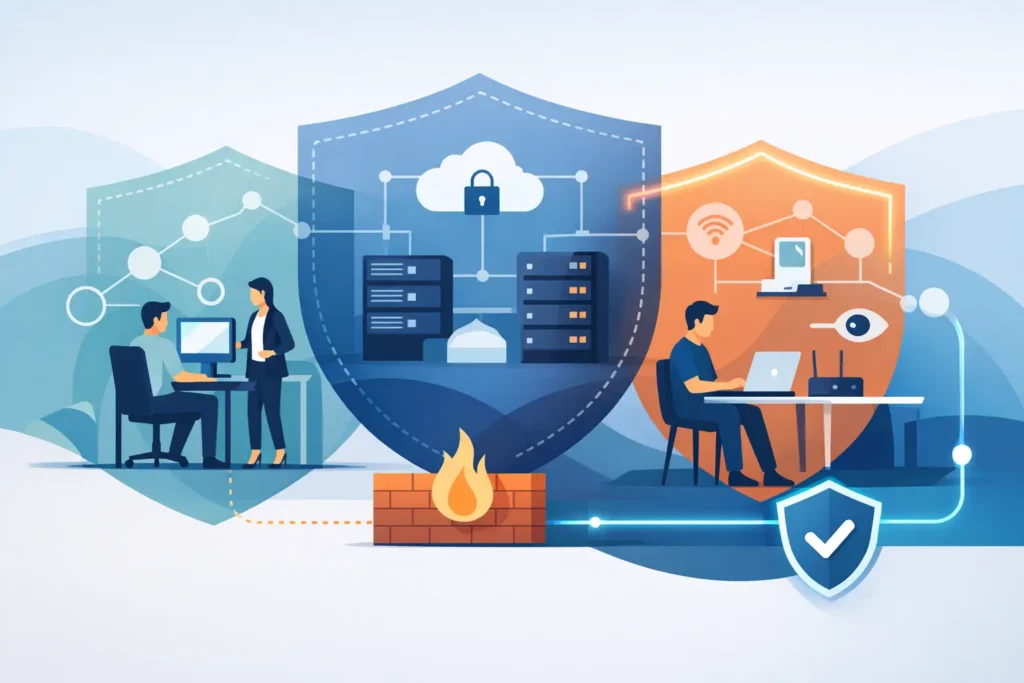
A compromised visitor WiFi password should not provide a path to finance files, IP phones, building controls, or executive devices. Yet many offices still operate with a single flat network where every connected device can potentially communicate with every other device. Office network segmentation changes that exposure by dividing the environment into controlled zones with specific access rules.
For business owners and IT leaders, the objective is practical: contain threats, protect essential services, and keep teams productive without making daily work more difficult. The right design supports growth and simplifies management. The wrong design creates access issues, workarounds, and support calls. That is why segmentation should begin with how the business actually operates, not with a list of network equipment.
What Office Network Segmentation Actually Does
Network segmentation separates devices, applications, and users into logical groups. These groups may use separate VLANs, subnets, wireless SSIDs, firewall policies, or a combination of these controls. Traffic between groups is not automatically trusted. It is permitted only where there is a clear operational reason.
Consider a typical office. Employee laptops need access to business applications, cloud services, printers, and possibly internal file servers. Guest devices usually need internet access only. Security cameras need to communicate with recording equipment and authorized viewing stations, but not with payroll systems. IP phones require reliable access to call services, while smart meeting-room equipment may need tightly limited cloud access.
On a flat network, these systems sit together. If one endpoint is infected, an attacker may try to discover other devices, capture credentials, move laterally, or interrupt services across the office. Segmentation reduces the available paths. It does not replace endpoint protection, multifactor authentication, backups, or employee awareness training. It gives those protections a stronger network foundation.
Segmentation is more than separate WiFi names
Creating a guest WiFi network is a useful start, but it is not a complete segmentation strategy. Separate wireless names must also be backed by correct VLAN assignment, firewall rules, and isolation policies. Otherwise, a guest network may still reach internal resources that should remain private.
The same principle applies to wired devices. A camera, printer, access-control panel, or conference-room controller should not gain broad access simply because it is connected to an office switch. Each class of device needs an appropriate level of trust and a defined communication path.
Start With Workflows, Not Hardware
A well-designed segmented network reflects business workflows. Before changes are made, map the people, devices, systems, and data that are essential to operations. This assessment should include both visible systems, such as workstations and servers, and often-overlooked devices, such as printers, wireless access points, video conferencing units, HVAC controllers, and smart office systems.
The key question is simple: what needs to communicate with what, and why? A finance workstation may need secure access to accounting software and a designated printer. A warehouse tablet may need only an inventory application. A facilities team may need access to building management controls but not to customer records. Defining these requirements before implementation prevents policies that are either too permissive or too restrictive.
Most offices benefit from separating at least four areas: corporate users, guest access, voice and collaboration services, and IoT or operational technology devices. Larger environments may add dedicated zones for servers, management interfaces, development systems, payment systems, or third-party vendors. The number of segments is not a measure of security maturity. Clear boundaries and carefully managed rules matter more than complexity.
Protect the systems that control the network
Network switches, firewalls, wireless controllers, and cloud management portals deserve special attention. Administrative access should be available only to authorized IT personnel and should be separated from everyday employee traffic. If a standard user device can freely reach network management interfaces, a single compromised account can create a much wider incident.
This management zone should use strong authentication, limited access sources, and logging. It should also be reviewed as staff roles and external support arrangements change. Segmentation is not a one-time configuration task. It is an operating discipline.
Build Access Rules Around Least Privilege
Once zones are defined, firewall policies control traffic between them. The safest starting point is generally to deny unnecessary traffic and allow only the services that have been verified as required. For example, a user VLAN may be allowed to reach a print server on a required port, while guest devices are blocked from all internal networks.
This approach is often called least privilege. It does not mean denying employees the tools they need. It means granting the smallest practical set of permissions needed to perform a task. Done well, it reduces attack paths without affecting normal work.
There are trade-offs. Strict policies can interfere with legacy applications, device discovery, wireless casting, or vendor-managed equipment if they are introduced without testing. Some systems use changing cloud addresses or nonstandard communication methods. These cases need documented exceptions rather than broad, permanent rules such as allowing all traffic between segments.
A phased rollout helps maintain continuity. Test policies with a small user group or a noncritical department, confirm that phones, printers, meeting rooms, and applications work as expected, then expand the configuration. A rollback plan and current network documentation are essential whenever critical services are involved.
Give Wireless, Voice, and Smart Devices Their Own Boundaries
Modern offices rely on far more than computers. Enterprise WiFi, SIP phones, cameras, access control, digital signage, sensors, and automation platforms all share the same physical infrastructure. They should not all share the same security level.
Guest WiFi should be isolated from internal systems and monitored for misuse. Corporate WiFi should authenticate approved users and devices before assigning them to the appropriate network. For organizations with mobile staff or multiple sites, identity-based access controls can apply policies consistently whether a user is in the office, at home, or connected through a secure remote-access service.
Voice traffic deserves its own consideration. Separating IP telephony can improve quality of service and reduce the chance that heavy data use affects call quality. It also limits exposure between phones and user devices. However, voice segmentation must be designed alongside call platforms, emergency calling requirements, and support processes, not added as an afterthought.
IoT and smart office devices are another priority. Many are built for convenience and long service life rather than frequent security updates. Place them in a dedicated segment, restrict their access to only the controllers and cloud services they require, and avoid allowing them to initiate connections to sensitive business systems. This is particularly valuable where automation, surveillance, and access systems operate around the clock.
Monitor What Crosses the Boundaries
Segmentation provides value only when the organization can see and manage it. Firewall logs, network monitoring, endpoint alerts, and configuration backups help IT teams identify unusual activity and respond before a small issue becomes a wider outage.
Reviewing inter-segment traffic can reveal a workstation attempting to scan cameras, an unknown device joining a sensitive VLAN, or an application using an unexpected service. These events do not always indicate an attack, but they deserve investigation. Visibility turns security policy into an active control rather than a static diagram.
Regular reviews are especially important after an office expansion, a cloud migration, a new telephony deployment, or the addition of smart systems. Old exceptions accumulate quickly. A rule created for a temporary project may remain long after the project has ended, leaving an unnecessary route into a protected zone.
For organizations without an in-house network security team, a managed infrastructure partner can provide ongoing monitoring, documentation, firmware maintenance, and support for policy changes. INSOURCE UAE approaches segmentation as part of the full environment, connecting network design with WiFi performance, cybersecurity, cloud services, telephony, and operational support.
Common Mistakes That Weaken Segmentation
The most common mistake is creating VLANs without enforcing firewall policies between them. This separates traffic on paper but may not limit access in practice. Another is using one broad rule to solve every compatibility problem. Broad rules are convenient during setup, but they can erase the security benefit of the design.
Organizations also underestimate documentation. Every segment should have an owner, a purpose, an addressing plan, and a record of approved communication paths. Without this information, future changes become slow and risky, especially when a business depends on external support or operates across multiple locations.
Finally, do not ignore performance. Security controls should be sized for real traffic volumes, including internet use, cloud applications, video calls, backups, and inter-site connectivity. An undersized firewall or poorly planned wireless design can create latency that users interpret as an application problem. Security and performance must be planned together.
A segmented office network gives a business room to grow without extending trust to every device by default. Start by identifying the systems that cannot be allowed to fail, then build clear boundaries around them. The result is a more controlled environment where everyday connectivity remains easy and a single incident is far less likely to become a business-wide disruption.