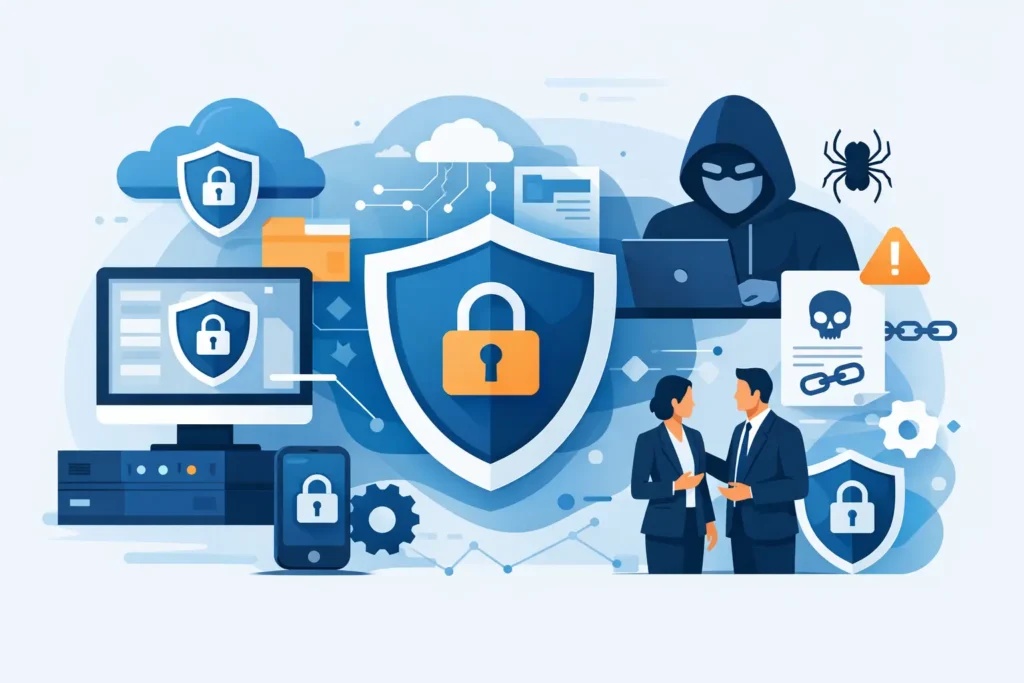
A ransomware incident rarely begins with a dramatic warning. It often starts with a convincing email, a reused password, an unpatched device, or a remote access account that was never properly secured. By the time files become unavailable and a ransom message appears, the business may already be facing lost productivity, disrupted customer service, and a difficult recovery decision. Effective ransomware protection for businesses is therefore not one product. It is a planned set of controls that prevents attacks where possible and keeps operations moving when prevention is not enough.
For business owners and IT leaders, the objective is clear: protect critical data, maintain access to essential systems, and recover without allowing criminals to dictate the next step. That requires security, infrastructure, people, and support to work together.
Why ransomware creates an operational crisis
Ransomware encrypts files, servers, or entire environments so that an organization cannot use them. Many attackers also copy sensitive data before encryption and threaten to publish it if payment is not made. This creates two connected risks: operational downtime and potential exposure of customer, employee, financial, or business data.
The cost is not limited to the ransom demand. A business may be unable to access shared files, accounting platforms, line-of-business applications, email, phone systems, or cloud resources. Teams resort to manual workarounds, customer response times increase, and management must coordinate technical recovery, communications, and legal obligations under pressure.
Small and mid-sized businesses are frequently targeted because attackers expect security controls and recovery plans to be less mature. Enterprise organizations face different challenges, including larger environments, more identities, third-party connections, and a greater number of systems that must be restored in the correct order. In either case, the impact depends on preparation long before an attack occurs.
Ransomware protection for businesses starts with layers
A single antivirus tool cannot provide complete protection. It can identify known threats and suspicious behavior, but ransomware campaigns commonly combine phishing, credential theft, remote access abuse, and system vulnerabilities. Security must be layered so that a failure in one control does not immediately become a business-wide compromise.
Secure the entry points attackers use
Email remains a common delivery method. Business email protection should filter malicious attachments, unsafe links, impersonation attempts, and spam before they reach users. This should be supported by endpoint protection on workstations and servers that can detect unusual encryption activity, unauthorized processes, and suspicious attempts to disable security tools.
Identity security is equally important. Multi-factor authentication should protect email, cloud platforms, remote access, privileged accounts, and any system that holds sensitive data. A stolen password is far less useful to an attacker when a second verification step is required. Access should also follow the principle of least privilege: users receive the access needed for their role, not broad administrative rights by default.
Remote access deserves particular attention. Remote desktop services, VPNs, and cloud administration portals are valuable for flexible operations, but poorly configured access services are a frequent route into business networks. Restrict access, use multi-factor authentication, monitor login activity, and remove dormant accounts promptly.
Keep systems maintained and visible
Unpatched operating systems, servers, firewalls, applications, and network equipment give attackers opportunities to enter or escalate access. A practical patching process should prioritize critical vulnerabilities, test updates where necessary, and document exceptions rather than allowing them to remain unnoticed.
Visibility matters just as much as patching. Centralized monitoring can identify failed backups, unusual login patterns, endpoint alerts, and network activity that deserves investigation. A business does not need to operate a large internal security team to gain this visibility, but it does need clear ownership. Managed monitoring and responsive technical support can provide that coverage where internal resources are limited.
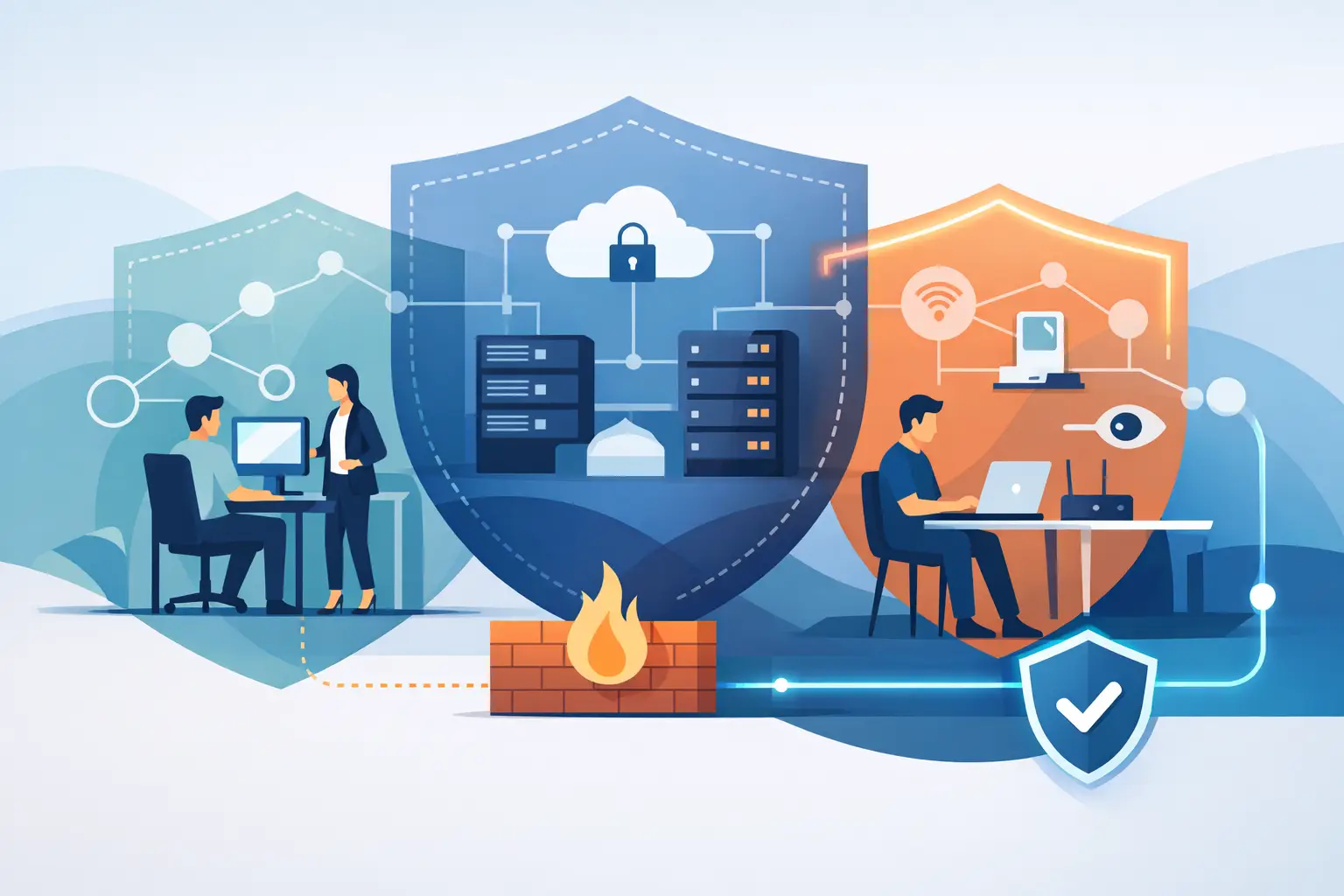
Network segmentation limits the damage when an endpoint is compromised. Separating user devices, servers, guest Wi-Fi, voice systems, security cameras, and critical operational equipment makes it harder for ransomware to move laterally across the environment. The right design depends on business size, applications, and operational requirements, but a flat network creates unnecessary exposure.
Backups are the recovery plan, not an afterthought
Backups are one of the strongest defenses against extortion, provided they can actually be restored. Attackers understand this and often target backup systems first. A backup that is connected to the same compromised network, protected by the same administrator credentials, or never tested may not be available when it is needed most.
A dependable approach includes multiple copies of important data, stored across different locations or platforms, with at least one protected from routine network access. Immutable or offline backup options can prevent backup data from being changed or deleted during an attack. Critical servers, cloud data, configuration files, and business applications should all be included based on their recovery priority.
Just as important, test restoration regularly. A successful backup job only proves that data was copied. It does not prove that a server, application, database, or file set can be recovered within the time the business can tolerate. Recovery testing reveals missing dependencies, outdated documentation, insufficient storage, and unrealistic recovery expectations before they become a crisis.
Build a response plan people can use under pressure
When ransomware is suspected, speed and coordination matter. An incident response plan should define who has authority to make decisions, who contacts the IT provider or security team, how affected devices are isolated, and how employees receive instructions. The plan should also identify critical vendors, insurance contacts, legal advisers, and communication responsibilities.
The first actions generally focus on containment: disconnect affected devices from the network without destroying evidence, protect backup systems, disable compromised accounts, and investigate the scope of the incident. Recovery should not begin until the organization has enough confidence that the attacker’s access path has been removed. Restoring systems too early can result in reinfection.
A useful plan should answer four practical questions:
- Which systems must be restored first to keep the business operating?
- Where are verified backups and the credentials needed to access them?
- Who can approve downtime decisions, external communications, and emergency spending?
- How will staff continue essential work if email, shared files, or telephony are unavailable?
Tabletop exercises are valuable because they test decision-making without waiting for a real incident. A short scenario involving a locked file server or compromised Microsoft 365 account can expose unclear responsibilities quickly. These exercises are particularly useful for organizations with distributed offices, remote staff, or facilities that rely on connected access, automation, and security systems.
Train employees without treating them as the weak link
Employees are often the final decision point between a phishing message and an incident, but training should be practical rather than punitive. People need to recognize unexpected payment requests, fake login pages, urgent password resets, unusual attachments, and messages that impersonate executives or suppliers.
Regular, brief training supported by realistic simulations is more effective than a single annual presentation. Staff should know how to report a suspicious email or device behavior quickly, and they should feel comfortable doing so. Early reporting can stop an attack before it reaches shared systems.
Technical controls still matter because even careful users can be deceived by sophisticated campaigns. The goal is not to rely on perfect human behavior. It is to combine informed users with email filtering, endpoint security, access controls, and monitoring.
Choose protection based on business priorities
There is no identical ransomware program for every organization. A professional services firm may prioritize email security, cloud data protection, and secure remote work. A company with on-premises servers may need stronger network segmentation, server monitoring, and fast local recovery. Organizations supporting multiple locations must account for internet resilience, centrally managed Wi-Fi, and consistent policies across sites.
The right investment should be guided by the systems that generate revenue, serve customers, meet contractual obligations, or support safety and operations. Define acceptable downtime for each system, then design backup, recovery, and support arrangements around that requirement. This is more useful than buying security tools without a clear recovery objective.
INSOURCE UAE helps businesses bring these elements together through secure network design, managed infrastructure, endpoint and email protection, cloud and server solutions, monitoring, and ongoing technical support. The value of an integrated approach is accountability: security controls, backup processes, connectivity, and recovery planning are managed as parts of one operating environment rather than separate projects.
The most reassuring ransomware strategy is not a promise that an attack will never happen. It is the confidence that your business can detect trouble early, contain it quickly, and restore critical operations with a tested plan and capable support behind it.